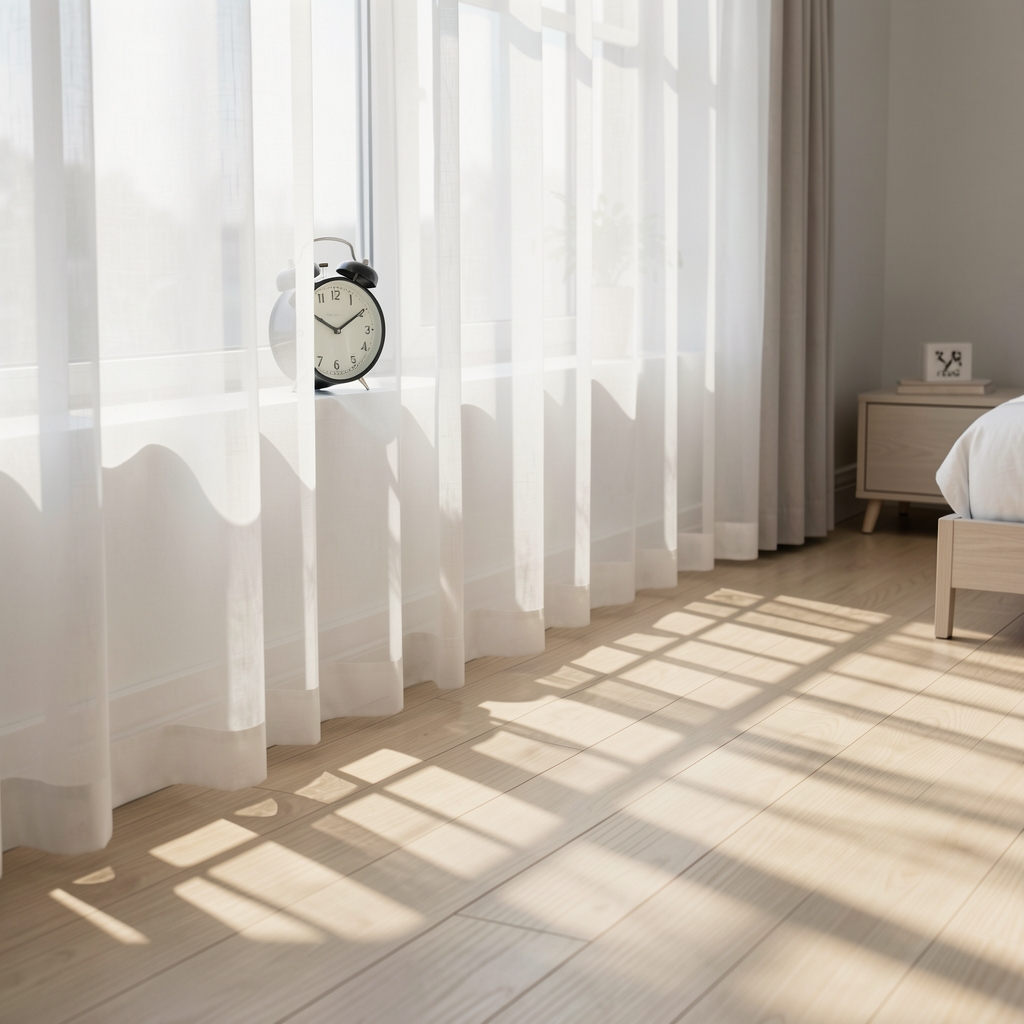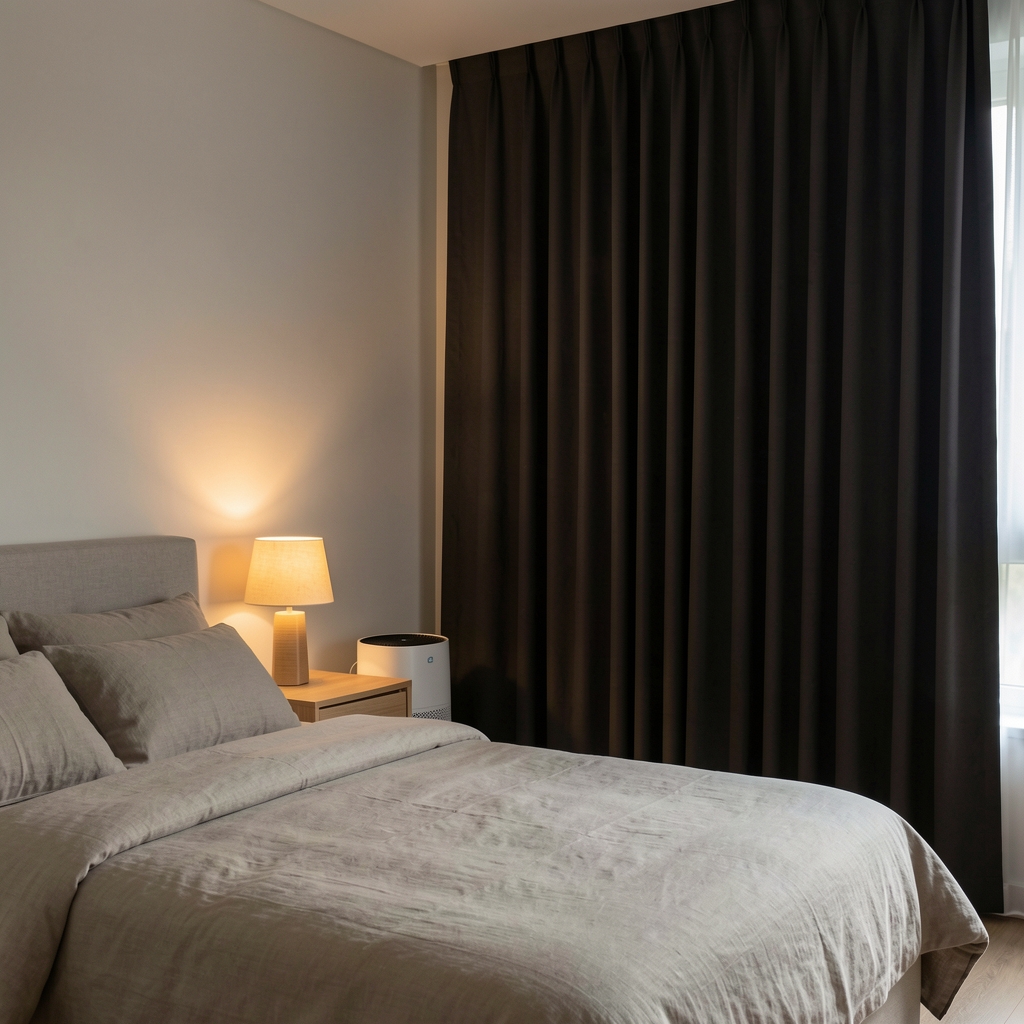
The physical space in which rest occurs is not a passive backdrop to the body's overnight work. The room's temperature, the quality and completeness of its darkness, the level of ambient sound, and the material qualities of the bedding and surfaces — each of these exerts a measurable influence on the body's capacity to move through its natural recovery cycles without disruption.
Darkness as an Active Condition
Darkness is not simply the absence of light. In the context of the rest environment, it is an active condition that exerts a direct influence on the production and sustained presence of melatonin through the overnight period. Research examining the effects of even low levels of light exposure during sleep has noted associations with reduced rest depth and altered recovery cycle architecture.
In urban UK environments, where street lighting, neighbour windows, and standby indicator lights on electronic devices contribute a persistent ambient illumination, genuine darkness during sleep is less common than it might appear. The lux levels that disrupt rest-phase melatonin production are substantially lower than those that register as noticeable to the waking eye. A room that appears adequately dark while seated and awake may still carry sufficient light to influence the body's overnight recovery environment.
Blackout curtains or blinds represent the most straightforward intervention, and their use in published studies is associated with improvements in rest onset and reported rest quality. Where installation is impractical, a well-fitted sleep mask can achieve comparable light exclusion, though the sensory experience of the mask itself may introduce a competing variable for some individuals.
“Darkness is an active condition. A room that appears adequately dark to the waking eye may still carry enough residual light to alter the overnight recovery environment.”
The Temperature Range for Restorative Rest
The relationship between room temperature and rest quality is among the more thoroughly documented environmental variables in the published literature. The body's core temperature follows a circadian descending pattern through the evening and overnight period, and a room environment that facilitates rather than resists that decline appears to support deeper and more complete recovery cycles.
Published research most commonly identifies a range of approximately 16 to 19 degrees Celsius as associated with optimal overnight rest for adults, though individual variation is real and the practical range extends somewhat on either side. The specific optimal temperature for any individual is influenced by age, body composition, the presence of a sleeping partner, and personal habituation. What the research does support with consistency is that warmer rooms — above 22 or 23 degrees — are associated with increased wakefulness, reduced slow-wave rest, and lower reported sleep quality across diverse populations.
In UK homes, where central heating is often controlled by timers set to maintain living temperatures through the early evening, the bedroom temperature at the point of sleep onset is frequently warmer than the evidence-informed target. The simplest intervention — reducing the heating timer so that the bedroom cools in the hour before sleep, or leaving a window slightly open — requires no equipment and carries no cost beyond the minor adjustment of habit.

The resting environment. Photographed under controlled studio lighting.
Acoustic Conditions and the Fragmentation of Rest
Acoustic disturbance during sleep operates at two levels: disruptions that are sufficiently loud or sudden to produce full waking, and lower-level disturbances that produce partial arousal responses — brief interruptions to rest depth that do not register as conscious waking but which accumulate across the night to reduce overall recovery quality.
Published studies examining noise in urban sleep environments — traffic, neighbour activity, intermittent domestic sounds — consistently find associations between higher ambient noise levels and reduced proportions of deep slow-wave rest, independent of self-reported waking. The body responds to sound during rest even when the subjective experience of the sleeper does not register disturbance. This means that a night spent in a noisy environment may feel subjectively adequate while producing less complete physical recovery than the same duration in quieter conditions.
The management of acoustic conditions in urban bedrooms is, in many cases, substantially less straightforward than the management of light or temperature. Building construction, proximity to roads, and neighbour schedules impose limits that no individual habit can fully overcome. Within those limits, interventions that have shown value include ear plugs (which not all individuals find tolerable), white or brown noise generation (which masks intermittent sounds by creating a consistent acoustic baseline), and the relocation of obviously disruptive devices — phones on vibrate, particularly, which generate impact noise at unpredictable intervals.
Textiles, Materials, and the Tactile Rest Environment
The material environment of the bed — the weight, breathability, and surface quality of bedding — is a variable that receives less attention in published research than light, temperature, and noise, but which shapes the rest experience in ways that are both measurable and subjectively significant. Bedding that traps heat or restricts movement contributes to the microclimate disruption that mirrors the effects of a warm room. Natural fibre textiles — cotton, linen, wool — tend to manage heat and moisture more effectively than synthetic alternatives, a difference that becomes most noticeable in warmer months.
The weight of the duvet or blanket occupies an interesting position: the published literature on weighted blankets, while still developing, suggests that increased tactile pressure can reduce objective movement during overnight rest for some individuals. The mechanism proposed is related to the calming effect of deep pressure stimulation on the nervous system's arousal state. The effect is not universal, and the appropriate weight appears to vary significantly between individuals.
What the evidence as a whole suggests is that the bedroom environment is worth treating as a considered composition rather than a functional space that rest simply happens in. Small adjustments — cooler, darker, quieter, with breathable materials — tend to compound rather than operate in isolation. The cumulative effect of attention to multiple environmental variables appears, in the research, to exceed the sum of individual interventions.
The Bedroom as a Dedicated Rest Space
Beyond the physical variables, the published literature on sleep hygiene consistently notes a behavioural dimension to the bedroom environment: the degree to which the space is used exclusively, or predominantly, for rest. The association between the bedroom and rest-conducive mental states appears to be shaped by habit — the body and mind develop an anticipatory response to the physical environment that prepares them for transition to rest.
When the bedroom doubles as a workspace, a screen-watching space, or a location for cognitively demanding activity, this association becomes diluted. The physical cues of the room no longer function as unambiguous signals for rest preparation. The practical implication — which appears in some form in most published guidance on rest quality — is that limiting cognitively activating activities in the bedroom, where the layout of the home permits, contributes to the room's effectiveness as a rest signal.
This is, in many circumstances, an ideal rather than a realistic directive. The constraint of limited living space, common in UK urban housing, means that strict separation of work and rest environments is not available to many people. The relevant principle, however, can be applied at a smaller scale: the deliberate transition of the room from its daytime uses to its rest configuration — closing the laptop, removing work materials from sight, dimming the lights — serves much of the same preparatory function as physical separation would, if practised with consistency.
- Even low levels of light during overnight rest are associated with reduced rest depth; blackout measures are among the highest-impact environmental adjustments.
- Room temperatures above 22 degrees are consistently associated with reduced slow-wave rest depth; 16–19 degrees is the range most commonly cited in published research.
- Acoustic disturbances that do not produce conscious waking can still reduce recovery quality by fragmenting rest at a depth below awareness.
- Breathable natural-fibre bedding tends to manage heat and moisture more effectively than synthetic alternatives.
- Multiple environmental adjustments — each modest in isolation — tend to compound in their effect on overall rest quality.